The Thirty Men of Castel Muzio: 1,300 Years of Village History
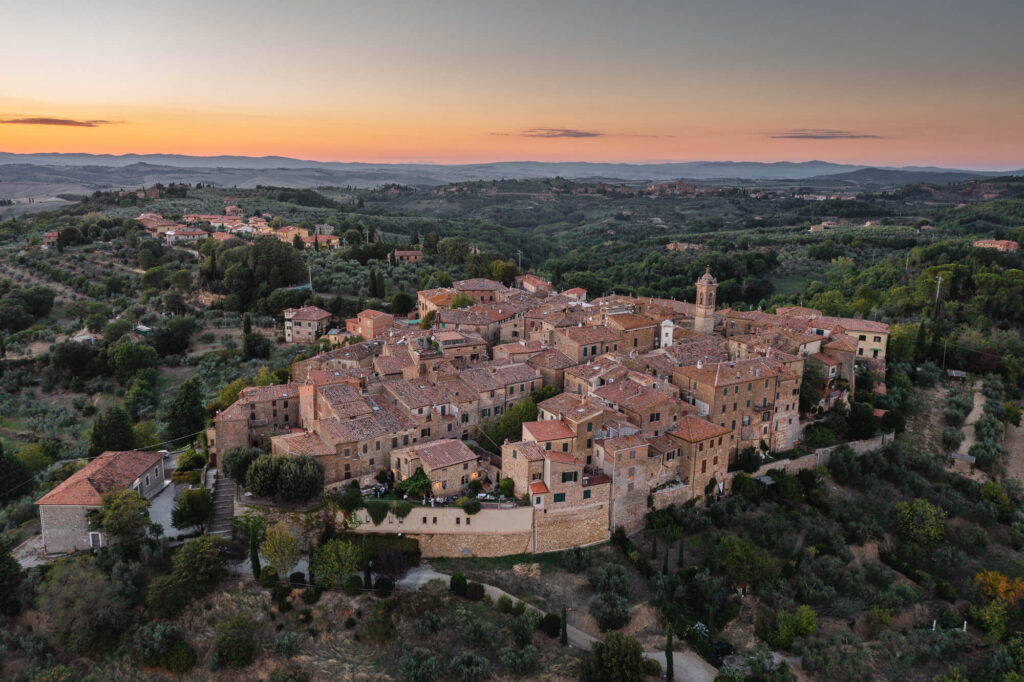
Long before anyone wrote the name Castelmuzio, people were already living, praying and arguing on this ridge. The village I call home has more than a thousand years of recorded life around it, and the best part of the story is not about lords or battles. It is about ordinary people who belonged to this place.
715: an old priest speaks
The earliest voice we can hear is that of a priest called Gunteram. In the year 715 the bishops of Siena and Arezzo were fighting over a string of country churches, and the Lombard king Liutprand sent a notary to question the locals. One of the churches was Santo Stefano a Cennano, right beside today's village.
Gunteram was already an old man. He explained that his church had always answered to Arezzo in matters of faith, but that when people here had a legal problem they went to the judge in Siena, because they lived on Sienese land. In one sentence he described the border country this has always been.
Santo Stefano was a pieve, a church with a baptismal font that served the whole surrounding countryside. A small monastery nearby depended on it. So even then this was not empty land: it was a settled, organised community.
881: farms around the church
The church appears again in 881, in a hearing held in Siena before Emperor Charles the Fat. This time the document mentions the houses and farms that belonged to it. Around Cennano there was already a worked landscape of fields and homesteads.
Then the records go quiet for a long time. That does not mean the land was abandoned. It only means nobody kept the paperwork.
1213: the thirty men of Castel Muzio
By the twelfth century these hills belonged to a powerful family, the Cacciaconti, who controlled the castles between Asciano, Trequanda and Montisi. But the city of Siena was growing fast, and after years of conflict the family had to accept its authority.
In October 1213 the men who lived on Cacciaconti lands were called to swear loyalty to Siena, village by village. In the city's great register, the Caleffo Vecchio, one line reads: the oaths of "the men of Castel Muzio, near Montisi". Thirty names follow.
This is the first certain record of the village. And it is more than a place name on a page. Those thirty men were written down as a group, identified by the place where they lived. They promised to protect the people of Siena and their goods, and not to send grain out of the territory without permission.
More than eight hundred years ago, thirty people were already known as "the men of Castel Muzio".
Wheat, rent and a village that ran itself
Ten years later, in 1223, two farmers called Burnaccio and Ugolino promised their lord a fixed yearly rent in wheat for a farm "in the district of Castelmuzio and Montisi". It was a small contract, but it shows a change: duties that once depended on the lord's will were now written down and agreed.
In the same decades the villages of this area learned to govern themselves. Neighbouring Trequanda had its own elected consuls by 1254. Village rules of the time dealt with very practical things: who repairs the roads and the walls, where animals may graze, how to protect vineyards, how to share the woods and the springs. A bell called everyone to the assembly.
The medieval statutes of Castelmuzio itself have not survived, but the idea behind them is easy to recognise. A community is not just people who happen to live in the same place. It is people who look after that place together.
The 1300s: the landscape you see today
In the fourteenth century wealthy families from Siena began buying land in the countryside. Scattered plots were joined into farms, each with its house, its vineyard, its fields and its patch of woodland, and each worked by a family who lived there and shared the harvest with the owner.
A contract from 1347 for a farm near Trequanda lists exactly that: vines, arable land and wood, a house, a yard, a barn and a threshing floor, two oxen and a donkey. Half the grain had to be carried to the owner's house in Siena.
This is when the countryside around us took the shape we still love: stone farmhouses on the hilltops, vines and olives, wheat fields and woods.
Why it matters to me
Many medieval villages have vanished. Some are a ruin, some only a name in an archive. Castelmuzio is still lived in. Families, work and customs have changed completely, yet the village has kept its name and its character through all of it.
When we set up the Borgo Salotto and turned the belvedere into an open-air living room, we were doing something very old: looking after a shared space together. I like to think the thirty men of 1213 would understand.
Sources: this article is based on a historian's talk on the medieval history of Castelmuzio and on the published documents it cites, including Il Caleffo Vecchio del Comune di Siena (ed. G. Cecchini, 1931) and the studies of Odile Redon on the rural communities of the Sienese countryside.